
Many brand customers often hear two words when doing OEM wet wipes: non-woven fabric and spunlace fabric. Many people may consider the two as two completely independent materials, but there is a common misconception here: hydroentangled fabric belongs to one type of non-woven fabric. The vast majority of wet wipes on the market are made of spunlace non-woven fabric.
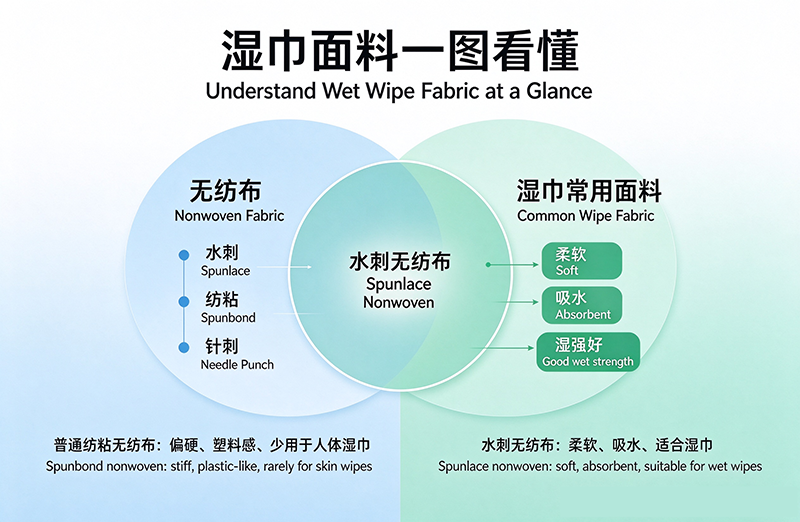
1、 First, clarify the concept: non-woven fabric ≠ hydroentangled fabric, but hydroentangled fabric belongs to non-woven fabric
Non woven fabric (non-woven fabric), not woven from yarn, is a general term for fabrics formed directly from fibers through processes such as bonding, needle punching, and hydroentanglement.
According to the production process, non-woven fabrics are divided into: water jet non-woven fabric, needle punched non-woven fabric, spunbond non-woven fabric, melt blown non-woven fabric, heat sealed non-woven fabric, etc.
✅ Water jet cloth is a non-woven fabric produced by water jet technology and is the most mainstream fabric for wet wipes.
❌ Misconception correction: Many salespeople mistakenly refer to "non-woven fabric" as spunbond fabric, which is not suitable for high-end wet wipes.
A brief introduction to various non-woven fabrics
1. Water jet non-woven fabric (the main fabric of wet wipes)
High pressure micro water jet sprays the fiber mesh, causing the fibers to intertwine with each other. The fabric is soft, has good drape, does not shed chips, and has strong water absorption.
Raw materials can be matched with: adhesive, polyester fiber (polyester), lyocell, wood pulp, etc., which can be made into plain weave, pearl pattern, mesh pattern, plain weave, concave convex pattern, etc.
👉 Applicable: Baby hand and mouth wipes, wet toilet paper, face towels, high-end cleaning wipes.
2. Spunbond nonwoven fabric
Made by extruding long filaments at high temperatures and bonding them together, it has a hard feel, high strength, low cost, poor water absorption, and fibers that are prone to fuzzing.
👉 Applicable: Disposable isolation clothing, mask outer layer, shopping bag, rarely used for close fitting wet wipes.
3. Needle punched non-woven fabric
Needle puncture entangled fibers, thick and fluffy, rough to the touch.
👉 Applicable: Geotextile, cleaning cloth, carpet, not suitable for wiping wet wipes on the human body.
4. Melt blown non-woven fabric
Ultra fine fibers with strong filtering performance.
👉 Applicable: Mask filter layer, not for use as wet wipes.
2、 Common raw material ratios for spunlace fabric (key selection points for wet wipe OEM)
Both are water jet fabrics, but with different raw materials, there are significant differences in hand feel, cost, and wet strength. Brand customers should focus on the ratio when selecting products:
1. Adhesive+Polyester (Polyester Fiber)
The most universal wet wipe fabric. Adhesive enhances softness and water absorption; Polyester increases wet strength and is less likely to rot when soaked in water. Common ratios are 50/50 and 70/30.
👉 Applicable: Ordinary hand and mouth wipes, multi-purpose cleaning wipes.
2. Wood pulp+polyester
Good water absorption and moderate cost; The proportion of wood pulp is high, and the wet strength will decrease.
👉 Applicable: Affordable wet toilet paper, disposable cleaning wipes.
3. Lyocell+polyester
Lyocell fiber is soft and silky, with a strong skin friendly feel, but the cost is relatively high.
👉 Applicable: High end baby wipes, face towels.
Fabric patterns: Pearl pattern, mesh pattern, and plain weave are just post embossing processes that do not change the base material, but only affect friction and thick hand feel. Pearl pattern has a stronger ability to grasp dirt and is currently the mainstream pattern of wet wipes.
3、 Quick differentiation: a simple method for identifying different wet wipe fabrics
1. Check the feel
-Water jet cloth: soft, like a cotton towel, with resilience when pulled; The pearl pattern has a textured surface with bumps and depressions.
-Spunbond non-woven fabric: hard and smooth, with a strong plastic feel, and feels thin to the touch.
2. Water immersion test (most intuitive)
-Water jet cloth: It still has toughness after being soaked in water and is not easy to break; Highly adhesive/Lyocell style, wet and soft, skin friendly.
-Spunbond fabric: becomes hard after being wet and has poor water absorption.
3. Combustion small test (factory incoming material testing reference, not recommended for consumers to operate)
-Adhesive/Wood Pulp (Plant Fiber): Burning like paper, flame stable, ash in powder form, with almost no plastic lumps.
-Polyester (polyester fiber): When burned, it melts, drips, has a plastic smell, and forms hard rubber particles after cooling.
4、 How do brand customers choose fabrics? OEM OEM selection suggestions
1. Baby hand and mouth wipes: Priority adhesive+polyester hydroentangled fabric, high softness and low dandruff, recommended pearl pattern.
2. Wet toilet paper: optional wood pulp mixed with water jet cloth, emphasizing the washability performance (washable wet toilet paper has a special dispersible formula fabric).
3. Industrial/object cleaning wipes: High polyester ratio can be selected, with strong tensile strength and wear resistance.
4. High end face towel: Lyocell blended hydroentangled fabric, with a delicate touch.