
Under the trend of environmentally friendly consumption, biodegradable wipes have become a differentiated new product direction for many brands. But there are many concepts in the market: biodegradable and dispersible, which many businesses easily confuse and even have false advertising.
This article helps brand customers clarify concepts, understand the true performance of biodegradable wipes, sort out the key points to avoid pitfalls in the entire process of OEM customization, and explain packaging promotion, qualification testing, and raw material selection in one go.
1、 Is biodegradable wipes reliable? First, distinguish easily confused concepts
1. Biodegradable wet wipes
The substrate is made of plant-based fibers such as wood pulp, adhesive, Lyocell, PLA polylactic acid, etc., which can gradually decompose in a suitable environment with microorganisms and temperature and humidity.
⚠️ Key point: Degradation requires a specific environment. The degradation rate of natural environments and ordinary landfills is very slow, and it does not disappear quickly after being thrown outdoors.
2. Disposable wet wipes (mainstream wet toilet paper)
Belonging to the subcategory of biodegradable fabrics, it has sufficient moisture strength when used, and after being flushed into the toilet, it disperses in the water flow and sewage pipe network environment without clogging the pipes. Can be dispersed ≠ rapidly degraded in any environment.
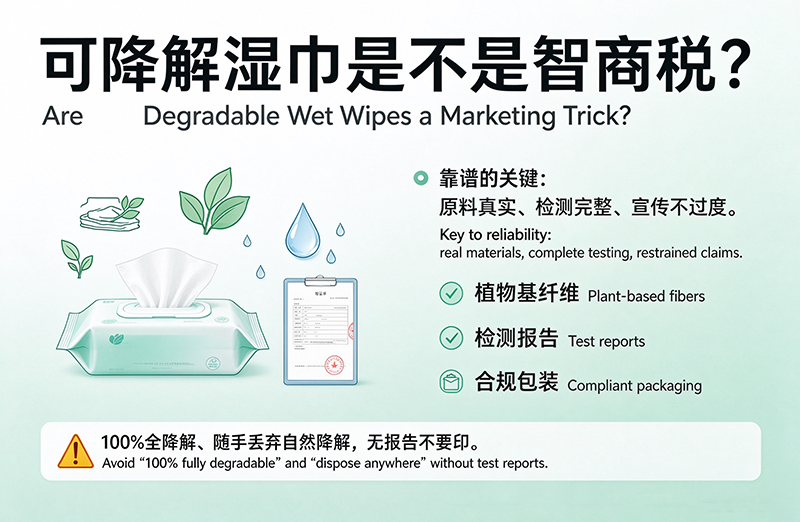
✅ Reliable biodegradable wet wipes: The substrate is made of cellulose plant fibers; Supporting CMA testing report, clearly indicating degradation conditions and execution standards; The original liquid formula does not hinder fiber degradation.
❌ Pseudo degradable: The fabric still contains a large amount of polyester (polyester fiber) and only a small amount of wood pulp, but claims to be completely biodegradable. Polyester belongs to petroleum based fibers and is difficult to biodegrade.
2、 Degradable wet wipes OEM customization, 7 core precautions
1. Raw material selection: Read the fiber ratio carefully, don't just listen to the term "degradable"
-Wood pulp/lyocell/adhesive: natural cellulose with good biodegradability, commonly used for flushable wet toilet paper and environmentally friendly cleaning wipes; The disadvantage is limited wet strength.
-Polyester (PET): petroleum based, non biodegradable, once added, it cannot be claimed to be 100% biodegradable.
>OEM reminder: It is necessary to have the factory provide a fabric composition testing report, clarify the fiber ratio, and specify the raw material ratio in the contract to avoid mismatching the goods.
2. Compliance of promotional copy and packaging (highest risk point)
According to GB/T 41010-2021 "Biodegradable plastics and products - Degradation performance and labeling requirements", environmental claims cannot be written arbitrarily
✅ Compliance writing: The substrate contains XX% wood pulp fibers and is biodegradable (with a test report indicating the degradation environment and implementation standards)
❌ Strictly prohibited: 100% biodegradable, discarded naturally biodegradable, fully biodegradable, household compostable (without corresponding testing)
>Additional note for foreign trade orders: Export to the EU with compostable claims requires EN13432 certification; The US market refers to the ASTM D6400 standard, and without certification, relevant words cannot be printed.
3. Confirm the testing report in advance and identify CMA qualifications
Before labeling, it is necessary to obtain:
1. Non woven fabric material composition testing
2. Biodegradability Performance Test Report (GB/T39951)
3. Wet wipes physical and chemical, microbiological, and skin irritation testing>
>Merely providing a fabric report is not enough. Wet wipe solution and preservatives can affect degradation performance, and the overall degradation testing of the finished product is only effective.
4. Product performance trade-off: Environmentally friendly fabrics have shortcomings
Degradable plant fiber fabric has characteristics compared to traditional adhesive+polyester fabric:
-Advantages: environmentally friendly concept, washable, suitable for wet toilet paper and household cleaning scenarios
-Shortcomings: Weak wet strength, poor tensile strength, and easy breakage; Higher requirements for formula and process; Cost higher than conventional wet wipes
During the sampling stage, it is necessary to test the wet strength, chip shedding, liquid absorption, and storage stability to avoid easy wiping and breakage after mass production, which may result in a large number of after-sales complaints.
5. The pit of packaging materials: only biodegradable cloth is made, packaging plastic bags are not biodegradable, and promotion still violates regulations
Many brands only focus on the base material of wet wipes and ignore the outer packaging film. If the base material of the wet wipes is biodegradable, but the plastic outer packaging is non biodegradable, it cannot be claimed that the entire package of products is biodegradable.
Optional solution: Equipped with compostable packaging film, degradation testing report is also required, which will further increase the cost.
6. Minimum order quantity, cost, and delivery cycle
Degradable fabrics and washable fabrics belong to special non-woven fabrics with limited raw material production capacity
-Unit price higher than conventional hydroentangled wet wipes
-MOQ minimum order quantity is generally higher
-The fabric stocking cycle is longer, and the sampling cycle is longer than that of ordinary wet wipes
Confirm the sampling fee, bulk delivery time, and price increase risk before cooperation, and include them in the OEM contract.
7. Category qualification differentiation
-Ordinary biodegradable cleaning wipes: managed as regular daily necessities
-Degradable sanitary/disinfectant wipes: disinfection product registration must be completed, and additional disinfection related testing must be prepared
>Just because the fabric is an environmentally friendly material, we cannot promote its antibacterial and sterilization effects at will, and still comply with advertising laws and disinfection label regulations.